Catholics pray to Mary by asking her to pray for them. They worship God alone and believe that Mary's intercession depends entirely on Jesus Christ. They can—and do—pray directly to God.
That short answer raises understandable questions. If Jesus is our Saviour, why ask His mother for help? Doesn't the Bible call Jesus the only mediator between God and humanity? And how can parents explain the Hail Mary to their children?
This guide explains the Catholic understanding, drawing on Scripture and the Catechism of the Catholic Church (CCC). Christians differ on the practice of asking saints in Heaven for intercession; the aim here is to explain Catholic teaching respectfully and clearly.
1. What Does It Mean to Pray to Mary?
In everyday English, prayer is often associated with worship. In older usage, however, to pray can also mean to ask. When Catholics speak of praying to Mary, they mean addressing her and asking for her intercession before God.
Intercession means praying on behalf of another person. Christians already do this when they ask a friend to pray for a sick relative or join their parish in praying for a family in difficulty. They are not treating that friend as divine.
James 5:16 encourages believers to pray for one another, while 1 Timothy 2:1 calls for prayers and intercessions for all people. Catholic belief extends this fellowship of prayer to the saints in Heaven through the communion of saints. Asking an earthly friend to pray is a helpful comparison, but it does not by itself establish that further belief.
Read: James 5:16; 1 Timothy 2:1. Catechism: CCC 2634–2636, 2673–2679.
2. Why Is Mary Special in Catholic Faith?
Mary's importance comes from her relationship with Jesus. Luke describes Gabriel announcing that she will become His mother, her faithful response, and Elizabeth greeting her as the mother of her Lord (Luke 1:26–43). Mary later says that generations will call her blessed (Luke 1:48).
Catholics call Mary Mother of God because the person she bore, Jesus Christ, is truly God and truly human. The title does not mean that Mary created God, gave Him His divine nature, or existed before Him.
Mary Points Towards Jesus
At the wedding in Cana, Mary notices that the wine has run out and brings the need to Jesus. She tells the servants to do whatever He tells them, and Jesus performs the sign (John 2:1–11).
Catholics see this as an example of Mary bringing a human need to her Son and directing others towards Him. It is an event from her earthly life, rather than an explicit account of someone praying to her in Heaven.
Read: Luke 1:26–48; John 2:1–11. Catechism: CCC 495, 963–970, 2674–2676.
3. Isn't Jesus the Only Mediator?
Yes. Catholic teaching affirms that Jesus Christ is the unique mediator and Saviour. As 1 Timothy 2:5–6 teaches, salvation comes through Him. Mary and the saints cannot replace His saving work.
The Catholic distinction is between Christ's unique mediation and the prayers of people united to Him. The same chapter that identifies one mediator also encourages intercession for others. Christians do not become alternative saviours when they pray for each other.
In Catholic teaching, Mary's prayer is entirely dependent on Christ. CCC 970 explains that her maternal role neither diminishes nor obscures His unique mediation. It is understood as sharing in His work by grace, never as an independent source of salvation.
- Jesus: the unique mediator and Saviour.
- Mary and the saints: creatures who intercede through Christ.
- Christians on earth: people called to pray for one another.
These roles are not equal. All Christian intercession depends on Jesus.
Read: 1 Timothy 2:1–6. Catechism: CCC 969–970, 2634.
4. Do Catholics Worship Mary?
Catholic teaching distinguishes adoration, which belongs to God alone, from veneration, the honour shown to the saints. Mary receives a special honour because of her relationship with Jesus and her example of faith.
Traditional theology calls divine adoration latria, honour for the saints dulia, and Mary's special veneration hyperdulia. Parents do not need to begin with these terms: the essential point is that Mary is honoured, not treated as God.
Kneeling during the Rosary, lighting a candle, or placing flowers near a statue can look like worship to an observer. Catholic teaching understands these as devotional gestures; neither Mary nor an image of her is divine. Genuine Marian devotion should encourage worship of God and faithfulness to Christ.
Read: Luke 1:48; Exodus 20:3–5. Catechism: CCC 971, 2132.
5. What Is the Communion of Saints?
The communion of saints is the fellowship of those united to Christ. In Catholic teaching, it includes believers on earth, those being purified after death, and the saints in Heaven (CCC 954).
Catholics believe that death does not end the Church's unity in Christ and that the saints in Heaven continue to pray for the Church on earth. Asking Mary for prayer expresses that communion; it is not a substitute for speaking directly to God.
Romans 8:38–39 speaks of the enduring love of God in Christ, Hebrews 12:1 describes a cloud of witnesses, and Revelation 5:8 depicts heavenly figures presenting the prayers of the saints. These passages contribute to Catholic reflection on communion and heavenly prayer, but none individually describes a Christian directly asking Mary in Heaven to intercede.
The Catholic case draws on Scripture read within Sacred Tradition, rather than one verse explicitly commanding prayer to Mary.
Read: Romans 8:38–39; Hebrews 12:1; Revelation 5:8. Catechism: CCC 954–957.
Help Children Understand the Prayer They Say
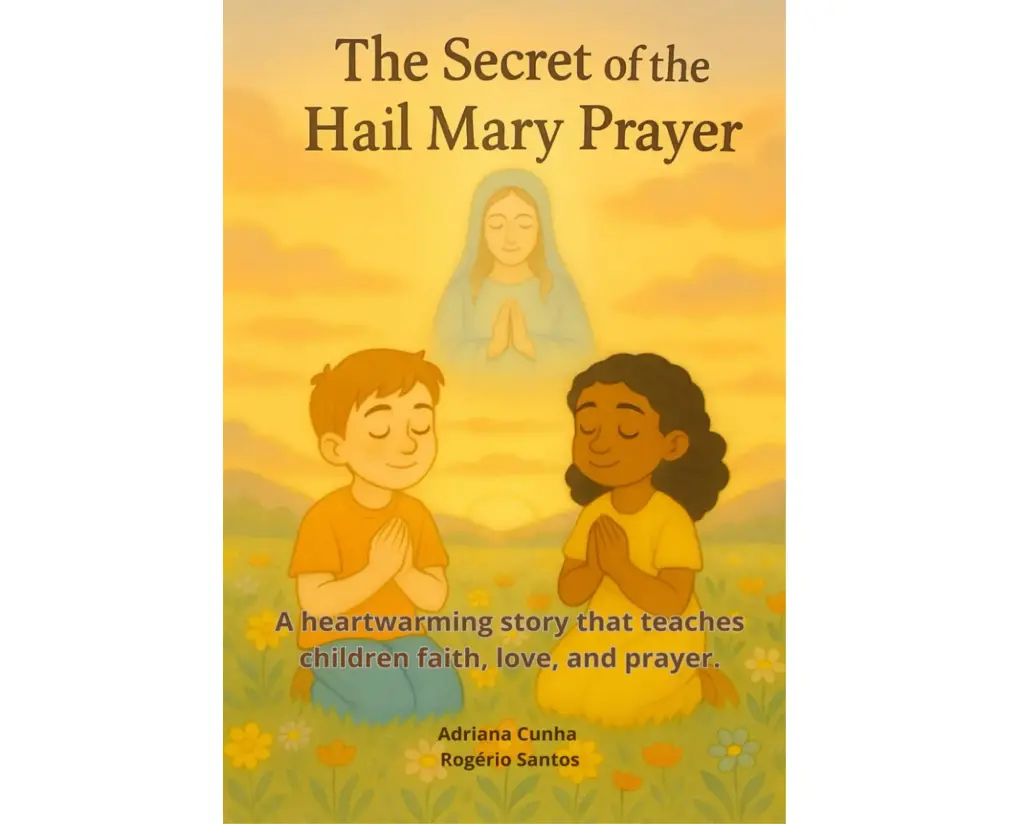
The Secret of the Hail Mary PrayerLooking for a gentle way to introduce these ideas at home? The Secret of the Hail Mary Prayer helps families explore the prayer through an illustrated story and conversations about faith and kindness. By Adriana Cunha and Rogério Santos. |
6. Why Do Catholics Say the Hail Mary?
The Hail Mary combines greetings from Luke's Gospel with a traditional request for Mary's prayers.
“Hail Mary, full of grace, the Lord is with thee”
The opening draws on Gabriel's greeting in Luke 1:28. Bible translations vary in their wording, including “favoured one” or “highly favoured”. The prayer's traditional wording recalls God's grace and Mary's calling.
“Blessed art thou among women, and blessed is the fruit of thy womb, Jesus”
This reflects Elizabeth's blessing in Luke 1:42. It honours Mary and, at the centre of the prayer, names Jesus.
“Holy Mary, Mother of God, pray for us sinners”
Here Catholics ask for Mary's intercession. The words acknowledge their need for God's mercy; they do not give Mary the place of the Saviour.
“Now and at the hour of our death”
The final request asks for her prayers throughout life and at its end. The second part of the Hail Mary belongs to the Church's prayer tradition; it is not a direct quotation from Luke.
Read: Luke 1:28, 42–43. Catechism: CCC 2676–2677.
7. Can Catholics Pray Directly to Jesus?
Absolutely. Catholics pray directly to Jesus, to the Father, and to the Holy Spirit. Asking Mary to intercede is not a condition for approaching God. Jesus taught His disciples to address the Father in the Lord's Prayer (Matthew 6:9–13).
Marian devotion is intended to support a life centred on Christ through prayer, Scripture and the sacraments. A simple explanation is: “We ask Mary to pray with us as we turn towards Jesus.”
8. How Can Parents Explain This to Children?
Start with a familiar question: “Have you ever asked someone to pray for you?” Then explain that Catholics believe Mary is with Jesus in Heaven and can pray for us too.
Use three short statements:
- God is the One we worship.
- Mary is Jesus' mother, whom we honour.
- We ask Mary to pray for us, and we can always pray directly to God.
Let children ask questions. They do not need to master every theological term before learning what the prayer means.
A Simple Family Reflection: Praying With Mary
- Read John 2:1–11 together. Notice how Mary brings a need to Jesus and directs the servants towards Him.
- Talk together. Ask: “What does Mary teach us about trusting Jesus?”
- Pray to Jesus. “Lord Jesus, help our family grow in faith, kindness and love. Teach us to follow You more closely. Amen.”
- Ask for Mary's prayers. “Holy Mary, Mother of God, pray for our family, that we may remain close to your Son, Jesus. Amen.”
- Put prayer into action. Choose one act of kindness for someone who needs care this week.
Frequently Asked Questions
Is Praying to Mary Forbidden in the Bible?
The Bible commands worship of God alone, and Catholic teaching agrees. Catholics distinguish worship from requesting intercession. Many other Christians disagree with invoking saints in Heaven; Catholics understand the practice through Scripture and Sacred Tradition, not an explicit biblical command to address Mary.
Why Not Just Pray to Jesus?
Catholics do pray to Jesus. Asking Mary or another saint for intercession is an additional expression of prayer within the communion of saints, not a necessary route to gain access to Him.
Does Mary Answer Prayers?
Catholics may speak of help received through Mary's intercession, but they believe that God is the source of grace. Mary does not possess divine power of her own.
Is Mary Equal to Jesus?
No. Jesus is the incarnate Son of God. Mary is a human being, honoured as His mother and a faithful disciple.
Where Can I Read the Church's Teaching?
Useful Catechism references are CCC 954–957 on the communion of saints, 969–971 on Mary's role and devotion to her, and 2673–2679 on prayer with Mary. Read the Vatican's Catechism section on Mary and the Church and its Compendium of the Catechism for further explanation.
Mary Points Us Towards Christ
In Catholic teaching, Mary's faith and intercession direct attention towards her Son. She does not replace Jesus or make God less approachable. The heart of the teaching is that the Church remains united in prayer through Him.
Family question: Who could we pray for today, and what practical kindness could accompany that prayer?
Explore the Hail Mary Together
The Secret of the Hail Mary PrayerContinue the conversation with The Secret of the Hail Mary Prayer. Share the illustrated story with your child, pause over the words of the prayer, and talk about putting faith, forgiveness and kindness into practice. By Adriana Cunha and Rogério Santos. |